Daily routines reduce stress

Daily routinesRoutines today play a huge part in our family, because our kids really don’t have any control over their day to day life, it can give them an opportunity to feel like they belong in the running of the household and provides a sense of order, control and predictability.

Routines have provided good habits  with structure around meals, sleep times and morning rituals. I am sure that even though my children don’t know it’s happening, they would be appreciative that they have this structure during key times of the day.

I started these routines the minute I move to a single parent life and it has continued on now for a few years.

Some of the positive take out have been:

  • Same time every morning and night when brushing teeth reduces push back from them in actually doing it.
  • Baths and showers before bedtime signifying the end of the day and they can hop into bed feeling clean and calm.
  • Breakfast, lunch and dinner always at the approximate same time, has reduced craving and grumpiness.
  • When it was housing cleaning time, it taught life skills, never always easy but I can say we have progressed from tidying up rooms to vacuuming and mopping floors  🙂
  • Enabled me to have some order around daily activities even whilst everything else may have been out of control.
  • It ensured that the important things got done.
  • We can then go on auto pilot and conserve energy and brain power.
  • It’s provided security and a sense of control.
  • It saves scrambling and allows us to focus on things.
  • Kids don’t cope with change very well and it has provided predictability.
  • Daily routines reduce stress in our lives

Routines have created a positive effect on my life.

OMG without a routine, getting ready in the morning would have been a nightmare.  I can say that our home is happier in the morning and pretty smooth sailing because of it.

For example:

Morning

Getting up and going can be hard whether young or old. If you find it hard getting started in the morning, having a solid routine established from first up in the morning means a much easier flow to the day.

I maintain the same alarm time to get up every morning and it means all the difference between having a good morning and having a bad one. I account for an extra 30 minutes for the potential of a hair hissy, sleepy kids or slow eaters.  It makes all the difference because we are not worried about those roadblocks that chew up time. Because my kids are in school it takes all the stress out. For example my daughter will  come out and say I cant do my hair correctly this morning? I say “Oh really, keep trying you’ll get it” with no stress. If I didn’t have the 30 minute buffer I could be saying “hurry up, we need to get moving” then all hell would break loose J

With getting up, having breakfast, getting dressed and brushing teeth and doing hair, there is really only one way for me to start the day off with practically no stress.

Mealtime

Mealtime also has been a good activity to establish good habits for us. We always have a good breakfast, maybe I am lucky but there has never been an option not to eat at breakfast time and I usually serve up, cereal, toast, fruit and a glass of milk or water (whatever they feel like). Yes it’s a lot and they usually only eat half of everything put in front of them. They go off to school knowing that they are well fed, I read once that it stops junk food cravings and grumpiness as lack of food brings all that on. This study also mentions how the lack of food reduces concentration, I think we get that!

Mealtime has also been a time that we sit together and just eat and talk about the day. We are not perfect, there are definitely times that we eat while watching some TV, just depends how the evening has gone but generally it’s always around the same time and homework or reading has been done.

Sleep

I found as the kids get older, it’s harder to get them to bed. For some reason they believe they are going to miss on ..who know what? I reckon too it is that they have much more fun running around than laying down to head off to sleep.

Sticking to a rigid sleep ritual has been a god send, well rested children are more pleasurable to be around. Next to eating, this would be No.2 priority. It reduces the amount of whinging and irritability that takes place and are much easy to reason with.

My kids routine starts with either having a quick shower, brushing teeth, going to the toilet and a story.  At the moment  I read a page, then they read a page and about 20 minutes into it they are tiring and its light out.

If I try and get them to bed even 15 minutes earlier than normal, they will fight sleep the whole way, so I found timing is everything. Sometimes if they are restless, I let them listen to some soft music with lights out and I come back in 10 minutes and they are usually off with the fairies.

Play

On weekends, my kids know that there will be sporting activities somewhere such as walking, bike riding or now and then doing something interesting like: indoor rock-climbing. It takes a little coaxing sometimes but when we get to it they are happy with the outcome. I balance it with down time so when we get back they simply lounge around and rest with normally a DVD.

They have come to expect it and it has also put a routine on me for planning such activities for the weekend.  Sometimes I feel we are the best tourist in our own cities.

It’s not a commando routine and that every minute of the day is structured – far from it! Rules got broken, flexibility has also been important when deciding what needs to be done and when?

I really can’t promote routines enough, it has been my saving grace and I am sure it has given me less stress than if I had no routine.


A Father’s Love is One of the Greatest Influences on Personality Development

A fathers loveFather’s Day is fast approaching. Few more days to go and we will be celebrating this day with overwhelming gratitude for our dads.

In a half-century study involving over 10,000 people from around the world, researchers from the University of Connecticut found that a fatherly love contributes as much, and sometimes more, to a child’s personality and development, as that of a motherly child.

Parental acceptance and why it’s so important

The researchers looked at 36 studies from various nations about how parental rejection affects a child’s personality and its development until adulthood. The studies were based on surveys that aimed to measure the parent’s degree of rejection or acceptance of their children. Rohner and Abdul Khaleque, study authors, found that children who have experienced parental rejection tend to become more anxious and insecure, and sometimes more aggressive and hostile towards other people as they grow up. This makes it more difficult for them to stay away from the cycle and become better parents. These adults are also less likely to form a secured and trusting relationship with their partners.

The feeling or rejection or acceptance is crucial to one’s personality development. According to Rohner, there’s emerging scientific evidence that reveals that there are parts of the brain that are activated when people experience physical pain and these regions are also activated when a person feels rejected. But the good thing is – people can revive this emotional pain over and over again, he pointed out.

Fatherly Love vs. Motherly Love

The researchers also studied the degree of impact of a father’s rejection or acceptance as compared to that of the mother’s.  Based on their analysis of the 36 studies, Rohner and Khaleque found that the influence of a father is oftentimes much greater as compared to the influence of the mother.  A group of experts working on the International Father Acceptance Rejection Project has one explanation for this. According to them, children and young adults tend to pay more attention to the parent which is perceived to be having a higher authority.  So if the child perceives his father to be of a higher authority, that child’s behaviour is more likely to be influenced by his dad.  More scientific investigations are needed to support this claim though.

An important realisation from this research, as explained by Rohner is this: fatherly love is critical to a person’s development. Knowing this would help motivate men to become more involved in rearing their children.  Furthermore, these findings will reduce the society’s ‘mother blaming’ attitude which is most observed in schools and clinical environments as more people realise that daddies, do have a major role to play too in developing a child’s personality.

Their findings were published in the Journal of the Society for Personality and Social Psychology.


Source of this article:

A Father’s Love is One of the Greatest Influences on Personality Development, Society for Personality and Social Psychology

Helping our kids deal with stress

To adults, childhood can seem like a carefree time. But kids still experience stress.  Things like school and social life can sometimes create pressures that can feel overwhelming for kids. As a dad, you can’t protect your kids from stress — but you can help them develop healthy ways to cope with stress and solve everyday problems.

Kids deal with stress in both healthy and unhealthy ways.  A study conducted by KidsHealth revealed they may not initiate a conversation about what’s bothering them, kids do want their parents to reach out and help them cope with their troubles.

But it’s not always easy for parents to know what to do for a child whose feeling stressed.

Here are a few ideas:

Notice out loud. Tell your child when you notice that something’s bothering him or her. If you can, name the feeling you think your child is experiencing. (“It seems like you’re still mad about what happened at the playground.”) This shouldn’t sound like an accusation (as in, “OK, what happened now? Are you still mad about that?”) or put a child on the spot. It’s just a casual observation that you’re interested in hearing more about your child’s concern. Be sympathetic and show you care and want to understand.

Listen to your child. Ask your child to tell you what’s wrong. Listen attentively and calmly — with interest, patience, openness, and caring. Avoid any urge to judge, blame, lecture, or say what you think your child should have done instead. The idea is to let your child’s concerns (and feelings) be heard. Try to get the whole story by asking questions like “And then what happened?” Take your time. And let your child take his or her time, too.

Comment briefly on the feelings you think your child was experiencing. For example, you might say “That must have been upsetting,” “No wonder you felt mad when they wouldn’t let you in the game,” or “That must have seemed unfair to you.” Doing this shows that you understand what your child felt, why, and that you care. Feeling understood and listened to helps your child feel supported by you, and that is especially important in times of stress.

Put a label on it. Many kids do not yet have words for their feelings. If your child seems angry or frustrated, use those words to help him or her learn to identify the emotions by name. Putting feelings into words helps kids communicate and develop emotional awareness — the ability to recognize their own emotional states. Kids who can do so are less likely to reach the behavioural boiling point where strong emotions get demonstrated through behaviours rather than communicated with words.

Help your child think of things to do. If there’s a specific problem that’s causing stress, talk together about what to do. Encourage your child to think of a couple of ideas. You can get the brainstorm started if necessary, but don’t do all the work. Your child’s active participation will build confidence. Support the good ideas and add to them as needed. Ask, “How do you think this will work?”

Listen and move on. Sometimes talking and listening and feeling understood is all that’s needed to help a child’s frustrations begin to melt away. Afterwards, try changing the subject and moving on to something more positive and relaxing. Help your child think of something to do to feel better. Don’t give the problem more attention than it deserves.

Limit stress where possible. If certain situations are causing stress, see if there are ways to change things. For instance, if too many after-school activities consistently cause homework stress, it might be necessary to limit activities to leave time and energy for homework.

Just be there. Kids don’t always feel like talking about what’s bothering them. Sometimes that’s OK. Let your kids know you’ll be there when they do feel like talking. Even when kids don’t want to talk, they usually don’t want parents to leave them alone. You can help your child feel better just by being there — keeping him or her company, spending time together. So if you notice that your child seems to be down in the dumps, stressed, or having a bad day — but doesn’t feel like talking — initiate something you can do together. Take a walk, watch a movie, shoot some baskets, or make a meal together. Isn’t it nice to know that your presence really counts?

Be patient. As a dad, it hurts to see your child unhappy or stressed. But try to resist the urge to fix every problem. Instead, focus on helping your child, slowly but surely, grow into a good problem-solver — a kid who knows how to roll with life’s ups and downs, put feelings into words, calm down when needed, and bounce back to try again.

Parents can’t solve every problem as kids go through life. But by teaching healthy coping strategies, you’ll prepare your kids to manage the stresses that come in the future.

Reviewed by: D’Arcy Lyness, PhD, Information courtesy of KidsHealth

Bunnings Craft Kits

bunnings craft kit boysDid you know that Bunnings have a whole range of kids craft kits for both girls and boys.  There is everything from race cars  to pots and saucers.  The kits  contain everything you will need to complete the project:

 

  • Glue
  • Pre-cut wood
  • Ceramic
  • Paint pots
  • Brush
  • Stickers and rhinestones

They are a great idea, I have used them on those weekend afternoons and school holidays when we just want to relax at home and have something interesting for the kids to do. They cost between $15 – $20. Drop into your nearest Bunnings and check them out, the kids love them!

Why Are Girls Taller Than Me?


Dads Online - BoysWhen boys are growing up and there bodies start to change, they will have questions about these changes.  Below is a response to a commonly asked question that may help you.

You might have noticed that some of the girls you know are taller than the boys.  But you’ve probably noticed that out of the adults you know, most of the men are taller than the women. What’s going on?

Well, girls get a head start on puberty — and growing taller — because they usually start these changes between the ages of 8 and 13. Most boys, on the other hand, don’t begin until between the ages of 9 and 14. So that’s why girls are often taller than boys during that time.

Most boys may catch up — and even grow taller than girls. But it’s also important to remember that your genetics play a role in height. So if your mom and dad are tall, you’re more likely to be tall. And if your mom and dad are kind of short, you may be short, too. But nothing is definite.

You have to wait and see how it turns out, but you can also talk to a doctor if you’re concerned. Remember — not every adult male is tall. Many men who are considered “short” have gone on to have careers in the movies, the military, and even professional basketball!

There aren’t any exercises or magic pills to make you grow tall. But by being active and eating nutritious foods, you’re helping your body grow up healthy, just the way it should.


Content provided by Kids Health

Keep in touch – Skype

You will discover a whole new world of keeping in touch.
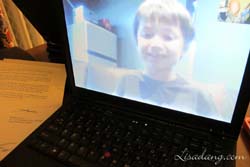

There has been some previous posting on the topic of “keeping in touch”, we thought another good way is to use Skype.  Skype is a software application that allows users to make voice or video calls over the Internet for free.  It is as simple as creating a free account with Skype.  You simply log on, select “Get Skype” from the home page and choose the computer system your using from the drop down menu i.e Windows or Mac?.  Follow the prompts, download and Skype runs a video tests and audio tests and then you are set to go.

Its a good idea to include a set of head phones so that you can chat without the worry of interruption.  Its that easy!

If you can, set up your child with their own Skype profile (It just needs a name and email account only)  Don’t be too worried about the profile info, there are ways you can keep their details private i.e. don’t fill out the profile info.  You can take extra precautions and now it might be a good time to discuss Internet safety.  Some other tips on Internet safety are as follows:

  • Parents should monitor their children while they are utilizing Skype.  If necessary, keep the computer in a common area, like the living room, or if the Skype is only for communication between yourself then you should have no concerns. They should turn it on to accept your Skype and off when you have finished.
  • Discuss “stranger danger” with your children, especially how to avoid contact with strangers online and what to do if one tries to communicate with them on the computer.
  • Make sure your child’s account is protected with a unique, long password that includes a combination of letters numbers, and characters.
  • Update your privacy settings for receiving communications. For a PC, open Skype and click “Tools.” Then go to “Options” and “Privacy.” On a Mac, open Skype and click “Preferences” and then “Privacy.”
  • If you want to keep it as private as possible, leave your profile completely blank.
  • If you think your account may have been compromised, change your Skype password immediately.
  • If a questionable incident occurs (like the one described above), contact your local authorities.  Be sure to save all pertinent information for the police, such as the predator’s user-name, time and date of the incident, and any other details about the conversation itself.

The Equipment

If they have complete access to a computer that’s great, if they don’t, you may be in a position to purchase a small laptop for them with internet access and built in camera are usually standard.  Laptops can be relatively inexpensive these days and a WiFi remote Internet cards are pretty cheap.

Lap-tops can be sourced through Officeworks or JB Hi FI for as little at $350. A wireless WiFi card can be as little as $15 a month through Dodo mobile broadband and if it is only used for your Skyping then that should be completely adequate.  You will be able to set up both your own and your child computer, chat and get approval from their mum to use Skype during the week  and if all is agreed to then it’s the next best thing to being there!

What kids really need from their dads

What kids really need from their dads. A 7 minute sampler of a brilliant 21 minute DVD from The Fathering Project, a University project, aimed at helping fathers and father-figures (such as stepfathers, grandfathers, teachers etc) understand what it is that kids REALLY need from them.  Described by teachers, fathers and psychologists with words such as ‘awesome’, ‘brilliant’, ‘deeply moving’ and ‘should be viewed by EVERY father or father-figure’.
see www.thefatheringproject.org for details.

Cyber Bullying

“Adults use the Internet, but children ‘live’ it”

John Bertrand, Chairman of
The Alannah and Madeline Foundation.

Young people see digital technology – including the Internet, social networking services and mobile phones – as a normal part of their social life and connecting with their friends, as well as sourcing information and for education purposes.

I remember a friend who told me that the primary school where their daughter attended set up an email account for all the students – remember they are primary school aged children!  When the children received their own personal email address they (as young people do) shared passwords! Friends logged into each others email account and sent emails out to their friends saying things like “I hate you” “you are ugly” “I don’t want to be your friend anymore” etc.

How could that school think for a minute that children could handle the responsibility associated with email and understand the consequences of actions like that is beyond me? You have probably guessed that the email accounts were shut down within a week.  Ask your school if they are registering for the program, I certainly will be! If not, what measures are they taking to educate and protect children within their school from Cyber Bullying?

This News update is to let you all know that The Alannah and Madeline Foundation in conjunction with  The Victorian and Queensland State Governments are rolling out a Cyber Bullying education program called “eSmart” for schools.  The uptake of the program has been huge with over 1000 schools signing up within weeks of it being launched.

A little about The Alannah and Madelaine Foundation,  The Centre Against Bullying and eSmart.

The Alannah and Madeline Foundation is a national charity protecting children from violence and its devastating effects.

They care for children who have experienced or witnessed violence and run programs which prevent violence in the lives of children. They play an advocacy role and are a voice against childhood violence.

The National Centre Against Bullying (NCAB) is a peak body working to advise and inform the Australian community on the issue of childhood bullying and the creation of safe schools and communities, including the issue of cybersafety.

NCAB is made up of a number of experts and works closely with school communities, governments and industry. It plays an important role in speaking out for children and advocating for their right to be free from bullying and other forms of violence.

About eSmart

eSmart equips everyone in the school community with the skills and knowledge they need for smart, safe and responsible use of technology.

eSmart helps schools to embed a culture of positive technology use, create policies and procedures, gain access to evidence-informed resources and track their progress in becoming eSmart.  Follow this link to more  information for Parents on eSmart and here for more Information for Schools

“As a parent, I would know that when I enrol my child in an eSmart school, it is a school where cybersafety and bullying are dealt with effectively. The teachers will know how to deal with incidents, children will look out for each other and can safely report bullying. As a parent I would know who to go to if my child was involved in anything risky online.” Dr Judith Slocombe, CEO, The Alannah and Madeline Foundation.
For more information on what Cyber bullying might look like follow this link.

Our kids are the main event

I was never allowed to participate in parenting, If I dressed my kids they would be too cold or hot, if I prepared a meal it was too spicy, when I cleaned their room it wasn’t done correctly? Maybe she was right? But that all changed when we separated.

It became my time to engage in parenting and to perform fatherly duties without the aggravation and arguments that came from a bad marriage.  I was able to dedicate time to getting better at all the things supposedly I was doing wrong?

Today I get no criticisms from the kids around how clean the house is (it is clean), what the meals taste like and my overall parenting skills…OMG maybe I got better! I dedicated a lot of time to practicing being a good parent and learning all the skills of being a great dad.   There is a good book called “Wednesday evenings and every other weekend” it has a story around dedicating time to the task of being a good parent.

The story talks about being a responsive parent and to clear your schedule and your mind of everything except your child, I think about this in way of being 100% present when ever you are with them.  It takes practice and even then I am guilty of not achieving 100% all the time.  The book has a good analogy: The circus understands this principle.  There might be three rings, but when the star appeared there was only one center ring – the only part of the big tent that was lit.

Our kids are the main event, the top of the bill, the one you have come to see.  Have you paid for a ticket to the big top?  Absolutely! You have spent thousands to be able to spend time with your child, to say nothing of your emotional investment.  Now sit back and fully enjoy that which you have given so much to see.  This is the V.I.P performance. At this moment you are the only ticket holder. You can find this book at Amazon:  “Wednesday evenings and every other weekend”  a second hand book can cost .12 cents with only $4 shipping, definitely worth a read.

It was my opportunity to parent, I loved showing the world that I was good at it and that dads are as capable and competent as mums.  I didn’t feel like I was missing out anymore,  I loved planning our weekends and including downtime on the couch just hanging out.  I worked hard at putting all the disappointment behind me and concentrated on our main event.

We know that divorce smacks the smile of your face and we feel run over by a semi trailer – No a B double! 🙂 But finding the quickest way to get over it and finding your smile will be the best thing for you and your kids.  If you feel that you are hardly ever present when your kids are with you, it might be worthwhile seeing a physiologist to help you get to a better place so that when the kids are with you they are the main event.  I did a couple of times, it helped me sort out crap and to be more fun with my kids.  There is a good health directory for practitioners in your area if you feel it could help.

Phillip Island Penguins

Seeing the penguins come home at night is a great experience for all ages. They have child tickets for those aged 4-15, inclusive. Children under 4 can enter for free and do not require a ticket. The boardwalks offer easy pram access. As the penguins arrive at sunset, it’s an earlier night for children when it’s not daylight savings time..

Where: 1019 Ventnor Rd, Summerlands 3922
Distance by car: An easy 90 minute drive from Melbourne
Contact: 03 5951 2800
Book online: http://www.penguins.org.au
Penguin arrival times: Summer between 6.00pm and 6.30pm
Other times: Winter between 8.00pm and 8.45pm
Payment: During holidays and long weekends always book online
Kids: Always Welcome

By car
Travel along the Monash Freeway (M1) away from Melbourne and turn off at the South Gippsland Highway exit.

Continue traveling on the South Gippsland Highway (M420) and follow the signs for Phillip Island onto the Bass Highway (A420). At the Anderson roundabout, turn right onto the Phillip Island Tourist Road (B420). At San Remo, cross the bridge onto Phillip Island.

Follow the signs to reach the Penguin Parade, Koala Conservation Centre, Churchill Island Heritage Farm or the Nobbies Centre. These attractions are no more than a 10-15 minute drive from each other.

TIP: If you’re trying to locate via GPS or Google Maps, note that Phillip Island is often spelled incorrectly as Philip Island or Philips Island.

Hey dad, why is the sea salty?

Have you ever been caught out not knowing how to answer one of those tough question, like many of us, a great response has always been “good question, lets look it up on Google”.  Below are a few of those questions and answers that we found on Google 🙂

 

HOW IS ELECTRICITY MADE?
Answer – It comes from magnets! In the early 1800s, Michael Faraday discovered “electromagnetic induction”, which is the scientific way of saying that if he moved a magnet through a loop of wire, the wire would become electrified.  In 1882, Thomas Edison opened the first full-scale power plant in New York City. Edison’s electric generator was a bigger version of Faraday’s basic experiment; a big magnet rotates around a wire to produce an electric current.  Today’s power plants are bigger and controlled by computers, but the basic process is still the same as it was nearly 120 years ago.

WHY IS THE SKY BLUE?
Answer – White sunlight is really a lot of different colours of light mixed together. Some colours of light travel through air and dust better than others. Red goes a long, long way.  But blue light gets bounced around a lot. Our blue sky is blue light that has been bounced out of sunlight by gazillions of molecules of air.

WHERE DOES THE WIND COME FROM?
Answer – Wind is “AIR IN MOTION” (or Moving Air) and is made by differences in the AIR PRESSURES. Warm Air rises, pushes up … (like when you open a heated oven’s door and the heat bellows out and goes straight UP to the ceiling like helium filled balloon.) Warm Air is light in weight. While on the other hand, Cold Air is heavy in weight and keeps closer to the earth’s surface. So wind is ‘made’ when the sun heats the earth’s surface and the air near the surface become warmer and lighter.  This warm air rises and while it is rising, cold/cooler air replaces where the warm air left.  Then that cool air is eventually heated and rises, too this process is continual. This movement of air is called, you guessed it…WIND!

WHY IS THE SEA SALTY?
Answer – The sea is salty because the rivers that flow into it wash salts and other minerals out of the ground.  These dissolve in the rivers and the rivers then flow into the sea. Another source of salt is the sea bed. As the Sun evaporates the water from the sea to make clouds, it leaves the salts and minerals behind, so the sea is much saltier than rivers and lakes.  Even though it rains on the sea as on land, this isn’t enough to dilute the salt.

HOW DO PLANES FLY IN THE SKY?
Answer – It may seem unbelievable that a heavy plane can get up into the air, but it’s all down to the clever shape of its wings.  If you look at a plane close up, you’ll see that the top of each wing is curved and the bottom is flat.  As the plane moves forward powered by the engine (in the same way your parents’ car goes when they turn on the engine), air pushes up on the flat bottom of the wing harder than it pushes down on the curved top.  This is what causes it to lift up into the air and then stay there.

WHAT MAKES THUNDER?
Answer – When you see a flash of lightning in the sky, it is often followed by a crashing boom of thunder.  This is because when lightning moves through the sky, it heats up the air to thousands of degrees centigrade – that’s hotter than the surface of the Sun. The heated-up air rushes away into the cooler air surrounding it.  This moving air makes a loud bang, and that is what we call thunder.

WHY DO YOU BLINK?
Answer – The very front of your eye is made of an extremely sensitive see-through screen rather like the windscreen on your parents’ car.  It’s very important that it stays clean and moist so that you can see as well as possible. So every ten or 20 seconds, your eyelids close, spreading a thin layer of tears over your eye which washes off any bits of dust or anything else that may have got into it, like a car’s windscreen wiper with squirty screen wash.  If we didn’t blink so much, we wouldn’t be able to see properly, so it’s lucky we do!

WHERE DO BABIES COME FROM?
Answer – You know chicks come from eggs and plants come from seeds? Well, humans are very special because we come from an egg and a seed.  The dad has the seed inside his body and the mum has the egg in hers, and they give each other a massive cuddle because they love each other so much, and that amazing big hug is like two pieces of a jigsaw fitting together, or two bits of Lego.  That way, the dad’s seed can meet the mum’s egg, and it makes a baby that will be born nine months later.

WHAT HAPPENS TO US WHEN WE DIE?
Answer – WHEN we die, we go back into the earth and the air and the plants, and become a part of all the world again.  Imagine a leaf unfurling bright green in the spring, and then stronger and darker in summer, then turning orange and falling to the ground in autumn.  In the winter, it melts down into the earth to give its goodness back to what will grow next spring. I think our life is like that.  But because human beings love each other, all of us live on in the memories of people we have known.

WHERE DOES WATER COME FROM?
Answer – Most scientists think the Earth’s water came from water-rich asteroids (really tiny planets) and comets raining down on the planet when it was young.  Others think the oceans were home-grown – they may have formed because the young Earth had a thick blanket of a gas called hydrogen, which reacted with chemicals in the Earth’s surface to form lakes and seas.


These are just some of the tough questions from children, if you have some experiences or have other answers, share them here.

Reconnecting after absence

Reconnecting after absence I found sometimes tricky, all I wanted was to pick up my daughter and start the weekend exactly where we left off (a fortnight ago) I was excited!

On occasion this was possible,  depending on what age she was at there were other factors. If it was early ages, I found sometimes that she would be quiet for a while and would not talk much other than yes/no. I had lots of practice asking non polar questions i.e. what was the best thing you did this week with your friends? or What books have you been reading lately?  and which one do you like the best?

There are reasons for quietness, things like: being tired, quiet for quiet sake, your ex has been verbally bashing you in earshot of the children (very uncool) so they feel conflicted, they need a little time to reconnect and sometimes they are confused.

It was always a non pressure time though, we just took our time and I spoke of what I’d been up to, things we might do over the weekend and it seemed to warm up.  What are your experiences?