The power of being present

Power of being presentIf you were to spend a lot of time with me a few years ago, you would have observed the serious and worry side of me. Today that side is still there but in a lessor degree because it gets replaced by a conscious effort to be present in the moment.
Those worries were varied, I could be walking around the supermarket looking for the diced tomato’s but instead my mind would be clouded with many troublesome thoughts all brought about from the complex issues around separation and shared parenting. I learned that our mind play games and we think about negative things that might never happen, in fact 95% of the time they never do.

Being present is one of the most talked about mental dynamics in spiritual life, and that it may be the single most important concept of living if your goal is to be happy and effective. In the absence of being present, we can live in a world of fear, anticipation, regret, anxiety and stress.

Our minds can take us back to the past, reminding us of painful times and our world of troubles, as well as into the future as it did with me, encouraging me to worry and stress.

I have learned to clear my mind and be present these days and i now carry less stress, not only for myself but everyone around me is happier. When your mind is present in the moment, we are less distracted with thoughts of what “might” happen or the negative intentions of other people.  We don’t get overwhelmed with negative reminders of hurtful experiences. Instead, when we are present, we simply get on with what needs to be done now, we are focused on the present moment.  If you are visiting a friend or you have your kids with you, you listen to them intently and with respect rather than allow your mind to wonder elsewhere.

It took quiet along time to get a handle on being present.  It is not something that I read then implemented the next day, it took practice,  but we all have the power to do it.  When our minds wonder from here to there, thinking about problems, becoming overwhelmed by thoughts of past or future drama’s. Its like we get lost in the content of our own thinking, and we don’t even realise it is happening, it just happens.

But i have learned and you can too that we have the power to recognise our own thinking when its taking us to a place we don’t want to go. When we do, we’re able to bring our attention back to the moment – to what ever we are doing or whoever we are with. With regular practise and when you can do this, you will notice that what ever your dealing with will be far less stressful.

Being present will reduce the stress you feel even if your handling a serious issue at that moment.

It is about consciously knowing how we can contribute or exacerbate the painful experiences in our lives by failing to recognise when our mind is taking us to a painful place. For example: We might be doing ok financially but are worrying ourself sick about saving for retirement.  Being more present is not saying don’t plan for your retirement but rather a way of moving through your life effectively without it ruining or magnifying the issue today.

My life today is easier, things that used to drive me crazy don’t so much nowadays, by practising being more present orientated, it has brought me peace of mind and less stress 🙂 have you been able to master this yet? let us know so that others can learn from your experiences too.


The secret to getting around a fussy eater

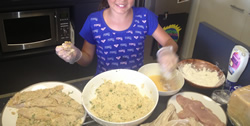
Matt Prestons chicken schnitzel and coleslawIf your kids are anything like mine and i think most are, they are fussy eaters.


Until recently i threw out a lot of everything I cooked for my daughter, mostly, when I was trying to introduce her to different foods.  She was stubborn when it came to trying something new, which I find strange because I am not a fussy eater nor is her mother?  AND then I got Matt Preston’s “100 BEST RECIPES” for Christmas.

I cooked Jackeroo pie and Chicken Schnitzel and Coleslaw and she asked for more on both occasions.  I believe the secret to getting around a fussy eater is to involve the kids in the cooking process. I was so impressed with the change in her eating habits that I contacted Matt and told him about it.

Matt sent the following message to all our dads online friends:

Few things give me more joy than cooking with kids. Few things also take longer to clean up but there’s no doubt that this is one way round the fussy eater in the family. What they’ve cooked, they tend to eat!

Matt Preston

matt-preston-s-best-100-recipes


Here is the recipe she likes the best so far…


Chicken Schnitzel and Coleslaw

  • 2 large chicken fillets (cut in half length ways)
  • 160g or 2 cups of fresh breadcrumbs
  • 40g 1/3 cup of finely grated parmesan
  • zest of a lemon
  • 1/4 cup of finely chopped parsley
  • freshly grounded black pepper
  • 1 egg, beaten
  • 125ml 1/2 cup of milk
  • plain flour for dusting
  • olive oil for frying pan
  • 2 lemons cut into wedges to serve

Coleslaw

  • 1/4 of a savoy cabbage
  • 1 carrot shredded
  • 1/2 red onion, thinly sliced
  • 235g 1 cup good quality mayonnaise
  • 1/2 bunch parsley leaves, washed and dried
  • 40g 1/4 cup currents

To prepare the schnitzels, beat the chicken until flat between two pieces of plastic wrap. Mix the breadcrumbs with the parmesan, lemon zest, parsley and pepper. In another bowl, whisk together the egg and milk. Dust the chicken with flour, dip it in the egg wash and coat with the breadcrumb mix. Place in the fridge for 30 minutes to allow the breadcrumbs to set.

Meanwhile, to make the coleslaw, mix the cabbage, carrot and red onion in a medium bowl with enough mayonnaise to bind. Set aside for 20-30 minutes to soften.

Heat the oil in a shallow pan and cook schnitzels for 4-5 minutes on each side to golden. Drain well on paper towel. Keep your schnitzels warm while you cook all the fillets.

Toss the the coleslaw with the parsley and currants, pile onto plates with the schnitzels and serve.

Let us know how you go, You, your kids and guests will love them! We even play the “Masterchef” game and score the dish on – taste and plating up appearance 🙂 On this dish I got a 10 for taste and a 7.5 for appearance! I obviously have some work to do?

The Hero Project

The Hero ProjectKhaaliq Thomas is a professional photographer and custodial dad of 3 (recently divorced). For the past year he has been working on a photo documentary concentrating on single / custodial fathers households.

We would like to spread the word and support his project so please like this page and share this story from our Facebook page.

Purpose of The Project
The project will challenge the belief of fathers being incapable, unwilling, and or inadequate in performing responsibly, productively and lovingly as a single / custodial parent. I currently have 3 participants and need another 3 to 4 for a truly diverse look into these unconventional family structures. Attention will be given to the dedicated ability of these dads and their commitment to raising productive children and supplying a stable home on their own. The finished project will consist of a 110 page full color photo book. He is using Kickstarter to raise the funds to search for more dads through advertising, print and design of the book and setting up exhibitions of the final project.

Play the video introduction of this project below.

hero final version from DARREN BROWN on Vimeo.

Dads Cafe Breakfast Menu

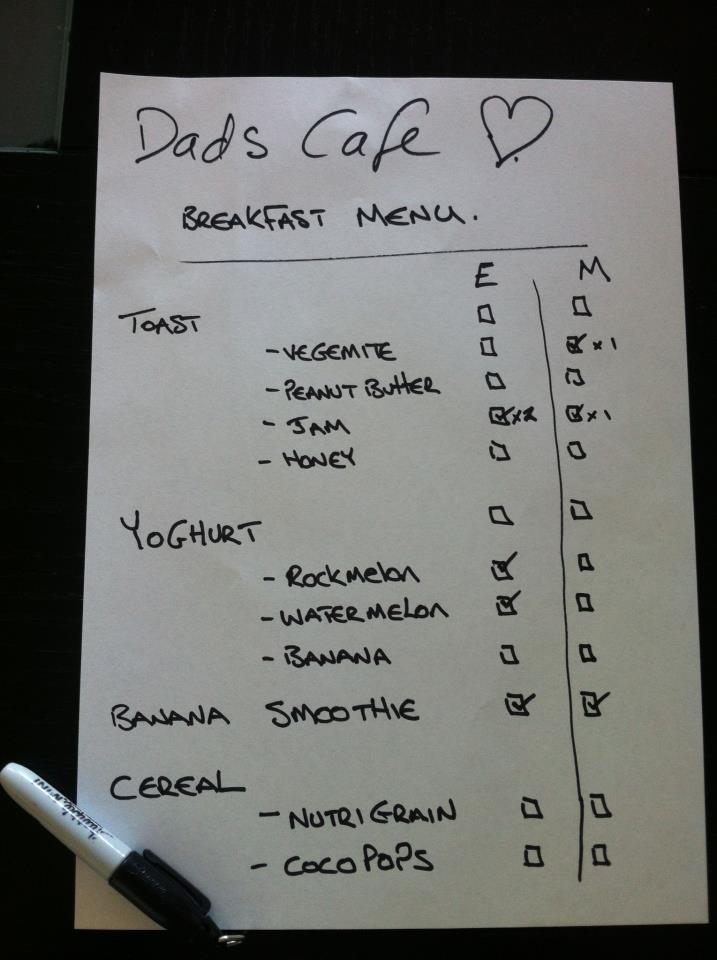
This is what breakfast looked like at our house this morning. Every now and then using an A4 piece of paper I draw up a menu similar to the ones we get in a cafe and we all get to order what we would like to eat. It’s a bit of fun as kids love to role play games and you can pretend you are a waiter. I just include on the menu what is available in the fridge and pantry at the time.

dads cafe menu

The Super Dad’s guide to a healthy kids birthday party

The Super Dad’s Guide To A Healthy Kids Birthday Party


Kids birthday parties can sometimes end with belly aches, nausea and sugar lows that are not much fun for anyone involved. Try to avoid sending home the neighborhood children with these symptoms by following our healthy party tips!

Don’t bring all of the food out at once

Lollies and kids go hand in hand and they will always choose an unhealthy food option over a healthy one any day. When you throw a party, put out a range of nutritious food platters that are healthy and filling and once you think the children are sufficiently full, you can offer the lollies and treats.

Smart drink choices

Water is the healthiest drink choice for everybody but when attending a party, the kids want something a little more tasty. Instead of juice, soft drink and cordial which are full of sugar, make them some slushies and smoothies using real fruit. You could even decorate the cups with a pineapple wedge or a strawberry for an extra special touch.

What to serve

It takes very little effort to provide tasty food that is both healthy and filling. A platter of sandwiches with a variety of fillings such as chicken and mayonnaise, egg and lettuce and ham and cheese are likely to satisfy everyones tastebuds. If you were thinking of doing hot food, mini pizzas with ham, cheese and pineapple are sure to please. Fruit sticks are a fun way to serve fruit. Thread watermelon, rockmelon, kiwi fruit and pineapple onto popsicle sticks. Add a marshmallow to each one as a surprise treat. For a final healthy treat idea, jelly cups with real fruit not only looks delicious but I’m sure your guests will think they taste great too.

Going natural

Where you can, go natural! Even though naturally flavoured lollies and chips still have a high sugar and fat content, you will be eliminating artificial colouring and flavouring which a lot of children have allergic reactions to and it can also affect their behaviour. The great thing about choosing these products is that they are usually free of preservatives too.

Swap the lolly bag for a treat bag

Instead of giving the kids lollies to take home, swap them for special treats. Bubbles, balloons, pencils, rubbers, stickers, toy cars, costume jewellery and temporary tattoos all make great treat bag ideas.

Have an sporty party

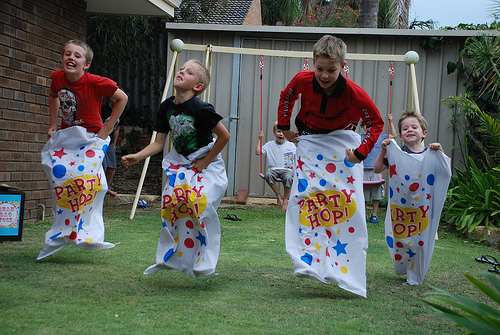
The choices for active parties these days are endless. You can have gymnastics parties, soccer parties, ten pin bowling parties and the any of your favourite sports team as theme. So even if the kids have had some sugary food during the party, they will well and truly burn it off before they go home.

At your next kid’s birthday party, try a few of the above ideas and see what a difference it makes. The only other important thing to remember is to send your party invitations out in time for the birthday bash.

Guest written by Mike Cutcliffe

Mike prides himself as a ‘super dad’ being a stay-at-home father of 3 boys while running his home-based IT business. He has recently held a 10th birthday party for his son and got everyone to dress as their favourite sports stars.

Developing our kids self esteem

self esteemHealthy self-esteem is like a child’s armor against the challenges of the world. Kids who know their strengths and weaknesses and feel good about themselves seem to have an easier time handling conflicts and resisting negative pressures. They tend to smile more readily and enjoy life.  These kids are realistic and generally optimistic.

In contrast, kids with low self-esteem can find challenges to be sources of major anxiety and frustration. Those who think poorly of themselves have a hard time finding solutions to problems. If given to self-critical thoughts such as “I’m no good” or “I can’t do anything right,” they may become passive, withdrawn, or depressed. Faced with a new challenge, their immediate response might be “I can’t.”

What Is Self-Esteem?

Self-esteem is similar to self-worth (how much a person values himself or herself). This can change from day to day or from year to year, but overall self-esteem tends to develop from infancy and keep going until we are adults.

Self-esteem also can be defined as feeling capable while also feeling loved. A child who is happy with an achievement but does not feel loved may eventually experience low self-esteem. Likewise, a child who feels loved but is hesitant about his or her own abilities can also develop low self-esteem. Healthy self-esteem comes when a good balance is maintained.

Patterns of self-esteem start very early in life. The concept of success following effort and persistence starts early. Once people reach adulthood, it’s harder to make changes to how they see and define themselves.

So, it’s wise to think about developing and promoting self-esteem during childhood. As kids try, fail, try again, fail again, and then finally succeed, they develop ideas about their own capabilities. At the same time, they’re creating a self-concept based on interactions with other people. This is why parental involvement is key to helping kids form accurate, healthy self-perceptions.

Parents and caregivers can promote healthy self-esteem by showing encouragement and enjoyment in many areas. Avoid focusing on one specific area; for example, success on a spelling test, which can lead to kids feeling that they’re only as valuable as their test scores.

Signs of Unhealthy and Healthy Self-Esteem

Self-esteem fluctuates as kids grow. It’s frequently changed and fine-tuned, because it is affected by a child’s experiences and new perceptions. So it helps to be aware of the signs of both healthy and unhealthy self-esteem.

Kids with low self-esteem may not want to try new things and may speak negatively about themselves: “I’m stupid,” “I’ll never learn how to do this,” or “What’s the point? Nobody cares about me anyway.” They may exhibit a low tolerance for frustration, giving up easily or waiting for somebody else to take over. They tend to be overly critical of and easily disappointed in themselves.

Kids with low self-esteem see temporary setbacks as permanent, intolerable conditions, and a sense of pessimism prevails. This can place kids at risk for stress and mental health problems, as well as real difficulties solving different kinds of problems and challenges they encounter.

Kids with healthy self-esteem tend to enjoy interacting with others. They’re comfortable in social settings and enjoys group activities as well as independent pursuits. When challenges arise, they can work toward finding solutions and voice discontent without belittling themselves or others. For example, rather than saying, “I’m an idiot,” a child with healthy self-esteem says, “I don’t understand this.” They know their strengths and weaknesses, and accept them. A sense of optimism prevails.

How We Can Help

As a parent we can help to foster healthy self-esteem in a child? These tips can make a big difference:

  • Be careful what you say. Kids can be sensitive to parents’ and others’ words. Remember to praise your child not only for a job well done, but also for effort. But be truthful. For example, if your child doesn’t make the soccer team, avoid saying something like, “Well, next time you’ll work harder and make it.” Instead, try “Well, you didn’t make the team, but I’m really proud of the effort you put into it.” Reward effort and completion instead of outcome.Sometimes, a child’s skill level is just not there — so helping kids overcome disappointments can really help them learn what they’re good at and what they’re not so good at. As adults, it’s OK to say “I can’t carry a tune” or “I couldn’t kick a ball to save my life,” so use warmth and humor to help your kids learn about themselves and to appreciate what makes them unique.
  • Be a positive role model. If you’re excessively harsh on yourself, pessimistic, or unrealistic about your abilities and limitations, your kids might eventually mirror you. Nurture your own self-esteem and they’ll have a great role model.
  • Identify and redirect inaccurate beliefs. It’s important for parents to identify kids’ irrational beliefs about themselves, whether they’re about perfection, attractiveness, ability, or anything else. Helping kids set more accurate standards and be more realistic in evaluating themselves will help them have a healthy self-concept.Inaccurate perceptions of self can take root and become reality to kids. For example, a child who does very well in school but struggles with math may say, “I can’t do math. I’m a bad student.” Not only is this a false generalization, it’s also a belief that can set a child up for failure. Encourage kids to see a situation in a more objective way. A helpful response might be: “You are a good student. You do great in school. Math is a subject that you need to spend more time on. We’ll work on it together.”
  • Be spontaneous and affectionate. Your love will help boost your child’s self-esteem. Give hugs and tell kids you’re proud of them when you can see them putting effort toward something or trying something at which they previously failed. Put notes in your child’s lunchbox with messages like “I think you’re terrific!”Give praise often and honestly, but without overdoing it. Having an inflated sense of self can lead kids and teens to put others down or feel that they’re better than everyone else, which can be socially isolating.
  • Give positive, accurate feedback. Comments like “You always work yourself up into such a frenzy!” will make kids feel like they have no control over their outbursts. A better statement is, “I can see you were very angry with your brother, but it was nice that you were able to talk about it instead of yelling or hitting.” This acknowledges a child’s feelings, rewards the choice made, and encourages the child to make the right choice again next time.
  • Create a safe, loving home environment. Kids who don’t feel safe or are abused at home are at greatest risk for developing poor self-esteem. A child who is exposed to parents who fight and argue repeatedly may feel they have no control over their environment and become helpless or depressed.Also watch for signs of abuse by others, problems in school, trouble with peers, and other factors that may affect kids’ self-esteem. Encourage your kids to talk to you or other trusted adults about solving problems that are too big to solve by themselves.
  • Help kids become involved in constructive experiences. Activities that encourage cooperation rather than competition are especially helpful in fostering self-esteem. For example, mentoring programs in which an older child helps a younger one learn to read can do wonders for both kids. Volunteering and contributing to your local community can have positive effects on self-esteem for everyone involved.

When promoting healthy self-esteem, it’s important to not have too much or too little but “just enough.” Make sure your kids don’t end up feeling that if they’re average or normal at something, it’s the same as not being good or special.

Finding Professional Help

If you suspect your child has low self-esteem, consider getting professional help. Child and adolescent therapists and counselors can help identify coping strategies to help deal with problems at school or home in ways that help kids feel better about themselves.

Therapy can help kids learn to view themselves and the world more realistically and help with problem-solving. Developing the confidence to understand when you can deal with a problem and when to ask for help is vital to positive self esteem.

Taking responsibility and pride in who you are is a sure sign of healthy self-esteem and the greatest gift we can give to our child.

We would like to acknowledge Kids Health for this content.

Protecting our kids from social media hackers

hacker safetyThe hacking of mass accounts on a social network is something that seems to be happening a great deal recently, with LinkedIn being the latest victim, after having 6.5m of its users passwords stolen.


Prior to LinkedIn, Twitter suffered a similar hack, and Facebook did too.

Social media profiles have become the target of social media hackers who use that data to further spread their maliciousness or gain access to your more sensitive data. It is always worth remembering that you can become a victim at any time. Not a day goes by when we don’t hear about a new hack, and with 55,000 new pieces of malware generated a day, security never sleeps.

With the latest security threat to LinkedIn fresh in our minds, here are 10 key social media security tips.

1. Think before you post! Status updates, photos, and comments can end up revealing more about you than you intended to disclose, and you could end up feeling like some silly politician as you struggle to explain yourself.

2. Think twice about allowing applications that request permission to access your data. You will be allowing an unknown party to send you email, post to your wall, and access your information at any time, regardless of whether you’re using the application. Before you decide if you want to allow the application access, make sure you know exactly what the application is!

3. Don’t click on short links that don’t clearly show the link location. With URL shorteners like bit.ly (and many more) are becoming increasingly common, it’s easy to forget that such URL’s can also be used by criminals to dupe you. Criminals often post phony links that claim to show you who has been viewing your profile. If you’re unsure about a link, you can test unknown links at SiteAdvisor by simply pasting the link into the “View a Site Report” form on the right-hand side of the page. Alternatively, if you use Hootsuite, you can see the extended URL or a shortened link by simply clicking the ‘+’ sign next to the shortened URL.

4. Beware of posts with subjects along the lines of, “LOL! Look at the video I found of you online!” When you click the link, you often get a message saying that you need to upgrade your video player in order to see the clip, but when you attempt to download the “upgrade,” the malicious page will instead install malware that tracks and steals your data.

5. Geolocation apps such as Foursquare share your exact location, which can also let criminals know that you aren’t home, so reconsider broadcasting exactly where you are. Remember, apps like Foursquare still allow you to gain check-in points without having to disclose your location on your Facebook and Twitter accounts.

6. Always use an up-to-date browser. Older browsers tend to have more security flaws, and it is very simple and quick to update your browser to the latest version.  Firefox is becoming the preferred brower to use when surfing the net, you can download it for free here: http://www.mozilla.org/en-US/firefox/new/

7. Choose unique logins and passwords for each of the websites you use. Yes, it’s a bit of a hassle to have different passwords for EVERY site you use, but it’s the best way to limit your exposure if (and probably when) a particular site you use gets hacked. I’m a big fan of password managers, which can create and store secure passwords for you.

8. Check the domain of the website to be sure that you’re logging into a legitimate website. So if you’re visiting a Facebook page from a link in an email, make sure the URL of the site is actually ‘www.facebook.com’ and not a site which looks like Facebook. Hackers often duplicate websites with the exact same design, and once you log into their fake site, they have your real login and password within seconds. This principle also applies to online banking websites, so be extra careful!

9. Be cautious of any message, post, or link you find on a social network that looks at all suspicious or requires to login again once you’re already logged in.

10. Make sure your security suite is up to date and includes antivirus, anti-spyware, anti-spam, a firewall, and a website safety advisor.

BONUS TIP: Take the time to understand your privacy settings! Select the most secure options and check periodically for changes that can open up your profile to the public. Facebook is renowned for continually changing its layout and one such change could result in information that was once private, now being public!

Have you ever had in social media security issues? Or do you have any additional tips? Let us know?

Things I wish I had of known earlier

Things I wish I had of known earlierSometimes it seems like the whole purpose of life is just to learn and grow. We learn from our mistakes. I reckon that most of us do not learn unless we have made some mistakes and have suffered its consequences.

I also believe that the majority among us keep on repeating the same mistakes again and again and in doing so, keep on attracting the same kind of circumstances in our lives and then keep complaining too.

There are some of us who learn from the mistakes of others. The majority among us though must go out there, make our own mistakes, learn from them, change our thinking and behavior and move on. These are the wise ones.

Learning from your mistakes is incomplete without a change in your thinking patterns. Changed thought patterns bring about changed behavior.

Here are some life lessons I and some friends have learnt after making mistakes.  I am sharing them with you in the hope that you may be among the wise ones.

  • The most sincere and selfless people around you are your parents. They maybe wrong sometimes and maybe hard on you but don’t just rebel against them without trying to understand their intentions first.
  • Save some part of your money whenever you get some and don’t touch it unless you really really need it.
  • Spend most of your money on things whose value increase with time, rather than immediate pleasure. It won’t last long otherwise.
  • There is no shortcut to being rich. Anyone who tells you so is lying.
  • Time is more important than money.
  • Family is more important than career.
  • Pursue what you love to do and be great at it and find a way to make a living doing that.
  • If you are unable to make a living while doing what you love don’t stop doing what you love to do, and while you make your living doing something else keep thinking how can do what you love and still live of it.
  • Make sure the people you love know it, no matter how busy you are. Never assume they know. Even if they know tell them anyway.
  • Read good books instead of watching TV. You will learn more and waste less time.
  • Don’t buy what they advertise just on an impulse. Take your time to decide if you really need that thing.
  • Change your friends if they do not share your values. It won’t kill you or your reputation.
  • Take risks but calculate the risks before taking them to see that you can handle the failure.
  • Plan your life but leave room for unplanned activities too. Let yourself experience the element of surprise.
  • Remember that nothing lasts forever. Nothing. So appreciate what you have when you have it.
  • It’s better to agree to disagree rather than trying to force your point of view on someone who doesn’t think like you do.
  • Accept your failures with grace and don’t bury yourself in depression when you don’t get what you want. There might be something better waiting for you.
  • Loving someone does not mean you have to agree on everything.
  • When you are doing something try to focus all your attention to just that task. Forget about everything else.
  • Be healthy. Exercise, eat healthy foods, sleep well and you won’t get to see very many doctors in life.
  • Don’t do things just because everyone else is doing them. Choose what you want to do consciously with specific reasoning.

Top family road trips in Australia

Twelve_Apostles_Victoria_AustraliaRalph Waldo Emerson’s famous words, “Life is a journey, not a destination,” still inspire today. The journey is the destination, or rather, it’s not the destination but the journey that matters most… For road trippers, the journey is just as remarkable as the destination, especially if you and your family are embarking on a summertime road trip in Australia.

Australia is a beautiful destination that offers pristine beaches, exotic wild animals and captivating scenery for road-tripping families. From beautiful rain forests and natural wonders to the thriving cities of Sydney and Melbourne, the diverse landscape of Australia provides ideal sites to travel and explore. Don’t forget to take a few steps to prepare. For example, check your engine at your local auto shop, get a car insurance comparison to ensure you have the best coverage, and create your own interactive and customized maps using ZeeMaps.com.

Take on any of the following road trips to amazing destinations for unforgettable experiences and discoveries that kids of all ages will enjoy:

Thredbo Resort

Planning a summer trip to the Australian Thredbo Resort is both scenic and adventurous from the moment your car hits the road to cruising downhill on your bike. Thredbo Alpine Village is outdoorsy family’s dream getaway, and the drive to the destination is just as much of an adventure as the resort’s thrilling activities. Leisurely scenic chair rides, fly fishing and mountain biking are among the many day adventures that families can partake in. Check out the spectacular views of Kosciuszko while abseiling, or take a Mt. Kosciuszko helicopter tour and experience the beauty of the wilderness from an incredible vantage point. From day trips and tranquil natural swimming holes to a scenic Kosciuszko Alpine Lakes Guided Walk, the Thredbo Resort is where to travel next.

Kosciuszko National Park

The alpine and stunning landscape of Kosciuszko National park is the perfect outdoor destination for hiking and biking families. The national park is home to Australia’s highest peak, Mount Kosciuszko, in the Australian Alps’ Snow Mountains Range. Adventurous climbers can ascend the summit while taking in breathtaking views along the way. Bushwalkers can also take the glacial Lakes Walk from Charlotte Pass to reach the mountain’s summit. For outdoor enthusiasts who love to feel the fast-paced thrills of mountain biking, and the popular trails Mosquito Creek, Blue Waterholes and Wallace Creek Trails provide unforgettable outdoor experiences and beautiful natural landscapes.

The Great Ocean Road, Victoria

Show your children the beauty of the Great Ocean Road in Victoria while driving past unimaginable views, including peaceful secluded bays, breathtaking cliffs and distinct rock formations. The Great Ocean Road, an Australian National Heritage, extends between the cities of Torquay and Warrnambool along the south-eastern coast. Kids will love to explore landmarks such as The Grotto, London Arch and Twelve Apostles as they continue along the world’s largest war memorial. Erskine Falls in the Great Otway National Park is also an excellent stop for everyone to experience the beauty of nature and gorgeous cascading falls.

The Great Green Way

Between Townsville and Cairns, Far North Queensland, the Great Green Way is exactly what its name implies. The gorgeous green way extends over 12 National Parks and 25 tropical islands. The relaxed way of life is defined by local pubs, farming and fishing. Travel to the various towns of Ingham, Mission Beach, Cardwell and Tully to meet with locals, nosh on tropical fruits and traverse the untamed wilderness. Take your family on an exploration to immaculate beaches on deserted islands and stunning coral reefs. While visiting the towns of the Great Green Way, experience Hinchinbrook Island aboard a ferry cruise, swim at Ramsay Bay, go snorkelling in the Great Barrier Reef or dive at the SS Yongala, a national historical wreck full of marine life and artefacts.

Sydney to Melbourne

Driving the Hume Highway from Sydney to Melbourne is a favourite and frequent road trip for Australian travel blogger Lee Atikinson. Tourists who are travelling to Sydney and Melbourne can turn the commute into an exciting road trip by stopping to watch the sunset over Lake Hume or exploring the small towns of Walwa and Tintaldra along the Victoria bank. The Snowy Mountains are picturesque scenery as the Alpine Way drive continues. Go horseback riding in Jindabyne, kayak in Tuross Lake and visit the shops of Tilba Tilba. As you and your children travel from the exciting city of Sydney to the cultural city centre of Melbourne, there’s always something new to discover.

Guest writer:  Ken Watkins, JournoMedia

A Christmas message from Victorian Counselling and Psychological Services

VCPSChristmas time and the holiday season can be a challenging period for single fathers.  When families are getting together and sharing experiences, those in separated families can experience loneliness and isolation.

It is important to ensure that you have some events scheduled with others who are supportive of your situation. You should plan your schedule in advance to include activities that you can look forward to.

You could create a list of others who are supportive of your situation including single fathers, members of your family, your children and friends. Then take the initiative to invite these people into your life over the holiday period; don’t just wait and hope to be invited by others.

You should also ensure that you have some activities just for yourself, especially if you are having time of from work. Whilst the holiday season can be a well earned break for some, others feel lost and isolated without their work routine.

It is also important to have time with your children and that you plan this in advance with others involved in your child’s care.  If you are stuck for ideas, you could look at “Kids” section of the following web site www.au.timeout.com

The new year period is also a good time to check in with yourself regarding your overall emotional health. An excellent place to start is the www.vcps.com.au website where you can download a free e-book – “Your guide to good mental health”.

By Robert Luzza
Psychologist & Director
Victorian Counselling & Psychological Services

The unchallengeable power of love.

The unchallengeable power of LoveI was sitting there on the sand facing the ocean. She was sitting in front of me, with her back against my chest. My arms around her, holding her close to me, I was touching her face. Her hair fluttered around in the wind that was caressing us lovingly—the wind of life passing by.

Clouds hovered above our heads, looking down and watching us with their invisible eyes, as if they wanted to capture the essence of that moment.

The crimson-orange sun was slipping into the ocean, bit by bit, moment by moment—as if deliberately—just to see us together one more time before embarking on its own journey, leaving behind just a yellow tint on the skyline.

I looked at the setting sun and it spoke to me, “Stay there my friend, as long as you are meant to be. Make this moment eternal. Freeze it in your heart like a beautiful painting, so that you can look at it when you need to—and you will need to someday!”

There was no noise. Just the sound. The sound of silence. The sound of the wind passing by. The sound of the waves coming, touching our feet—as if to kiss them—and going back, taking away with them the message of love into the ocean of eternity!

There were no words to say. No things to talk about. All was said and heard already. No questions remained. No answers were needed. All we needed was already there—Us!

We were two souls becoming one in that moment—the moment of a lifetime!

Just like in the heart of an atom lies an enormous power, which if allowed to explode can destroy everything around it, similarly, there exist moments in our lives, which if allowed to come to surface and open up, have the incredible power to demolish all the emotional blockages, that we take years to build, in order to keep our sorrows, hurts and suffering of our pasts locked up inside us.

We lock them up so that we can survive and go on with our “normal” lives. The lives that other people see us living. But only we know, that’s how other people perceive our lives to be, is not how our lives are. There is always an undercurrent of life that we live, along with a life that we live on the surface.

And then someday, something happens and that moment—which we always keep hidden inside us and avoid facing at all costs—comes to surface and explodes. Its utter intensity and colossal power takes on a life of its own.

We feel helpless in front of it. We give up because there is no other choice but to surrender ourselves before it. We let it do what it is supposed to do—to shatter to pieces all the bandages that we put on our hearts, wound by wound.

And then the storm bursts forth with an all-consuming force, and spills out of our eyes in the form of tears. They just come and come and come… We cry from the heart. Our souls shiver in the presence of such a moment and we—ourselves—become just like a tear. Wet from the inside out, drifting away from ourselves, going with the pull of the gravity of our emotions.

It doesn’t stop, unless everything is washed away. It doesn’t end, unless there is nothing left to cry about. It doesn’t rest, unless all that remains in our hearts is emptiness.

And emptiness is a blessing, because if your heart is already filled, you can not love anyone or anything, without creating a mess inside an already messy heart. Cleansing is important and that is what that moment does to us. It cleans out the past debris, leaving behind a heart as pure as gold.

People say that you can only love once in your life. They say that you can never forget your first love or your last love. I say that there is no first or second or last love. There is only love and we love the people we are supposed to love when it’s their time to show up in our lives.

You won’t be able to stop that feeling of love for someone when it is time for you to love him or her. Reasons don’t matter in the affairs of the hearts. Hearts come with a reasoning of their own.

And every love that you experience is different and yet the same. Each love leaves you with something immortal, eternal and changes you in an unchangeable way. And listen to me when I say this;

If you have loved someone, and that has not changed your life for good, you have never really loved.

That is the unchallengeable power of love.

People love and get hurt, and heartbroken many of them either fall into depression or turn toward avoidance by welcoming drugs and/or revengeful lust in their lives. They think that their lives are worth nothing, now that they can not be with the one they love.

What a wasteful approach toward love that is! What a sad, negative approach!

Yes it hurts and it hurts really bad when it happens, and yes it leaves its scars on your soul, but is that all that your loving someone gives you?

What about those golden moments when you felt complete with the person you loved? Don’t they mean anything to you now?

What about the ecstasy in which your spirit danced when you loved someone? Does that have no value for you, now that your beloved is not with you anymore?

Why not?

Love is just like life. It has its ups and downs. Sorrows and pleasures. Hurt and healing.

Why do we only focus on the hurts and forget about all the pleasures it lets us experience? Why we only remember the suffering and choose not to acknowledge its blessedness? Like I said, love is just like life. Love is life. Life is love.

So let’s treat it as life itself.

Strip away the hurt and let that moment dance in your heart which made you feel complete—even if for a second. Get rid of the suffering and let the glorious light of love shine in your spirit.

And as for the hurts and suffering—The Moment—which I talked about above, will take care of that. Your tears will wash it all away. Learn to cry like that. Learn to let that moment soothe your trembling heart. Learn to respect those healing tears—that holy water!

Yes that moment may not be a single moment. It may stretch itself to a day, a week, a month, a year or even a few years, but it always comes one day to take you in its healing and invigorating embrace.

And when your heart starts feeling light again—and it will—love that person even more. Keep him or her alive in your heart and be grateful, that he or she made it possible for you to feel love’s elation, its rapture, its intoxicating beatitude—the greatest emotion you as a human being can ever experience.

Let your sorrows be your sweetest songs, like Shelley so aptly and so beautifully said,

We look before and after,
And pine for what is not;
Our sincerest laughter
With some pain is fraught;
Our sweetest songs are those that tell of saddest thought.

As I heard these lines, I opened my eyes and the sun had already gone down. The night was waking up. The winds were still dancing around. The waves were coming and going as they were supposed to. Life was dancing on the tunes of destiny, as always.

The only one who was not there—was Her. She was gone with the sun. I smiled at her, at the ocean, at the winds, at the clouds, at myself, at life, at love and walked back to my life again—with my eyes almost dry, and a silence in my heart, the type of silence that floats over the stillness of our souls after a storm has just passed.

Blessing her one last time, I whispered to her soul that she will always remain in my heart, but only for the greatest emotions she allowed me to experience with her. I told her that I’ll be eternally grateful to her that she came into my life for however little a time, for whatever reasons.

And in the heart of my heart, I knew, that it’s not over—yet…

Story written by Abubakar Jamil.

Steady as you go

daily routineWhen you are going through a separation you are obviously going to be concerned about the effect that it has on your children. Everyone’s lives have suddenly been turned upside down and everything that we are used to is changing.  It can be a very unsettling time for our children, as well as you, so steady as you go,  it is important that the children keep a sense of security and familiarity.  Creating and maintaining routines can help to do this and also help you and your ex to find a new way of looking after your children.

Why Routines Are Good

Routines give children a sense of safety and security. Children experiencing a separation can feel like their whole lives are falling apart so the routine they have, the better.  Establishing routine visitation will help them deal with the separation as will know when to expect to see you again.  Maintaining the same daily routine, whether they are with their mother or you, will help ease the transition.

Daily Routine

From the moment that children are babies, establishing a daily routine is a highly beneficial.  Children react well to boundaries and knowing what to expect.  It can also help with their mental and physical health and sleep patterns. When your child is with you it can be tempting to score points by letting them stay up late or eat lunch in the afternoon, but it is important to maintain their normal routine.

Routine Visitation

Hopefully, you have been able to come to an agreement about visitation.  This is not only a good thing for you but also for your children.  They will be filled with uncertainty when you no longer live with them and it is important to make then feel as secure as possible.  By establishing a regular access pattern they will know that you are still a constant part of their lives.

Discussing Routines with Your Ex

In an ideal world you would be able to have a mature, constructive conversation with your ex whenever necessary.  Unfortunately, this is not always the case but you both need to work hard to maintain a good relationship for the sake of the children.  Building and breaking routines should not be about control or points scoring, it is about the best interests of your children.  There may be legitimate reasons why a routine needs to be changed and you should be able to openly discuss this.

Fortunately I have a good parenting relationship with my ex, If something comes up and I can’t have my child on a certain weekend then I forfeit that weekend and pick up the next one scheduled, this applies to her also.  At first this was quiet confronting as it means you will miss two weekends in a row (if you are fortnightly) without swapping but in reality, it works perfectly because I can note on a calendar in pen my days and weekends for the year and they never change.  If you are having trouble, consider some Mediation help to get you on the right track.

We acknowledge  http://www.separateddads.co.uk/ for some of this content.