
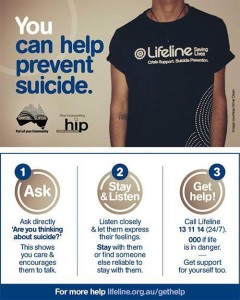
 R U OK? Day, Thursday September 12th 2013 is a national day of action dedicated to inspiring all Australians to ask family, friends and colleagues, ‘Are you ok?’ By regularly reaching out to one another and having open and honest conversations, we can all help build a more connected community and reduce our country’s high suicide rate.
R U OK? Day is on the second Thursday of September (12th September 2013).
More than 2,200 Australians suicide each year and men are around 3 times more likely to die by suicide than females (ABS 2012). For each person that takes their life, another 30 people attempt to end their own life (SANE Australia).
Most people don’t openly share their feelings, particularly if they’re struggling. The best thing we can all do is regularly talk to the people we care about – regardless of whether they are at risk – because connection is good for us all.
In the time it takes to have your coffee, you can start a conversation that could change a life.
Dads, who will you ask?
 WHAT THEY WANT AND WHY IT MATTERS TO WOMEN
 For some dads, an effort is made to maintain a fine balance between work and family since they consider them intertwined and equally important. Just as you can’t be with your children 20 hours per day and hold a job, or spend 20 hours per day at work and be an effective dad, occasional compromises between work and family are required to maintain a happy medium.
 Another dad, a teacher, goes into work early so when he comes home in the evening his family has his full attention. Some dads maximize precious family time by including their kids in everything they do or wherever they go outside of work. Rather than stay in a job that intrudes into family time and is inflexible, many of these dads look for a new job that enables family time. These dads aren’t immune from the challenges of separating career and family priorities. In practice they are willing and intentional in their effort to compromise as best they can keep their career and family roles balanced.
 The father’s behavior will in large measure be based on his sense of control, the flexibility of his job and family, and his willingness to engage in healthy compromise and boundary setting. Work and family will be out of balance when boundaries are absent or not enforced. Poor boundaries created by an out of balance condition can be generated by the father, or in some cases inflexible demands of the family, the job or the employer.
 Anyone with young children will know that whilst holidays are a fantastic opportunity to ‘get away from it all’ and spend quality time together. Sometimes the stress of the journey to get there can make you question whether it’s worth all the effort!
 Filmmaker Justin Hunt will be joined by musician-composer James Hetfield in presenting and discussing the award-winning documentary Absent, exploring the worldwide crisis of absent and disengaged fathers and the negative impact that the “father wound” makes on society.
 Divorce changes a lot of things in your family unit, but it does not change one of the major goals that parents often desire to achieve: the ability to raise your children in a way that puts their mental, emotional, and physical health first. Before your divorce, you and your spouse worked as a single unit to protect and provide for your children. Now you must work as separate units, all-be separate units that agree at times, to care for your children.
 Every parent wants to do a good job raising their kids.
 I have been a separated dad for over 25 years, twice over. Its something I am not proud of but I am proud of being a good dad. I have had two very different experiences. My first child was every second weekend, I did everything I could to be in her life – as much as I was allowed or welcomed.
 People often associate negotiations with deals between companies or purchases but in reality, the average person makes dozens of negotiations every single day. Whether it’s discussion with an (ex)spouse, pleading with children, or coming to a consensus on dinner plans with friends – negotiating is a part of everyday life. While everyone inevitably engages in some form of negotiation, not everyone is skilled at it. Luckily, it doesn’t require years of business classes to become a great negotiator. And the benefits of becoming a great communicator can be tremendous. Keep the following things in mind for future negotiations.
 Getting your first part time job is a proud moment in anyone’s life, and this will be no different for your teen.
 Once you have decided on that once in a lifetime road trip across the country, there is little you can do other than dream about your perfect getaway. But before you get lost in the clouds, come back down to earth and plan your trip properly before you go. This is ensure fewer obstacles and more time spent enjoying your adventure. Follow this simple guide and make sure you don’t forget anything important when planning your next road trip.















Recent comments